

Automobile
E20 Petrol Debate Intensifies in India: What We Know So Far
Fresh concerns over E20 fuel quality have emerged in India, while oil companies and the government maintain that the fuel meets prescribed standards.
Language
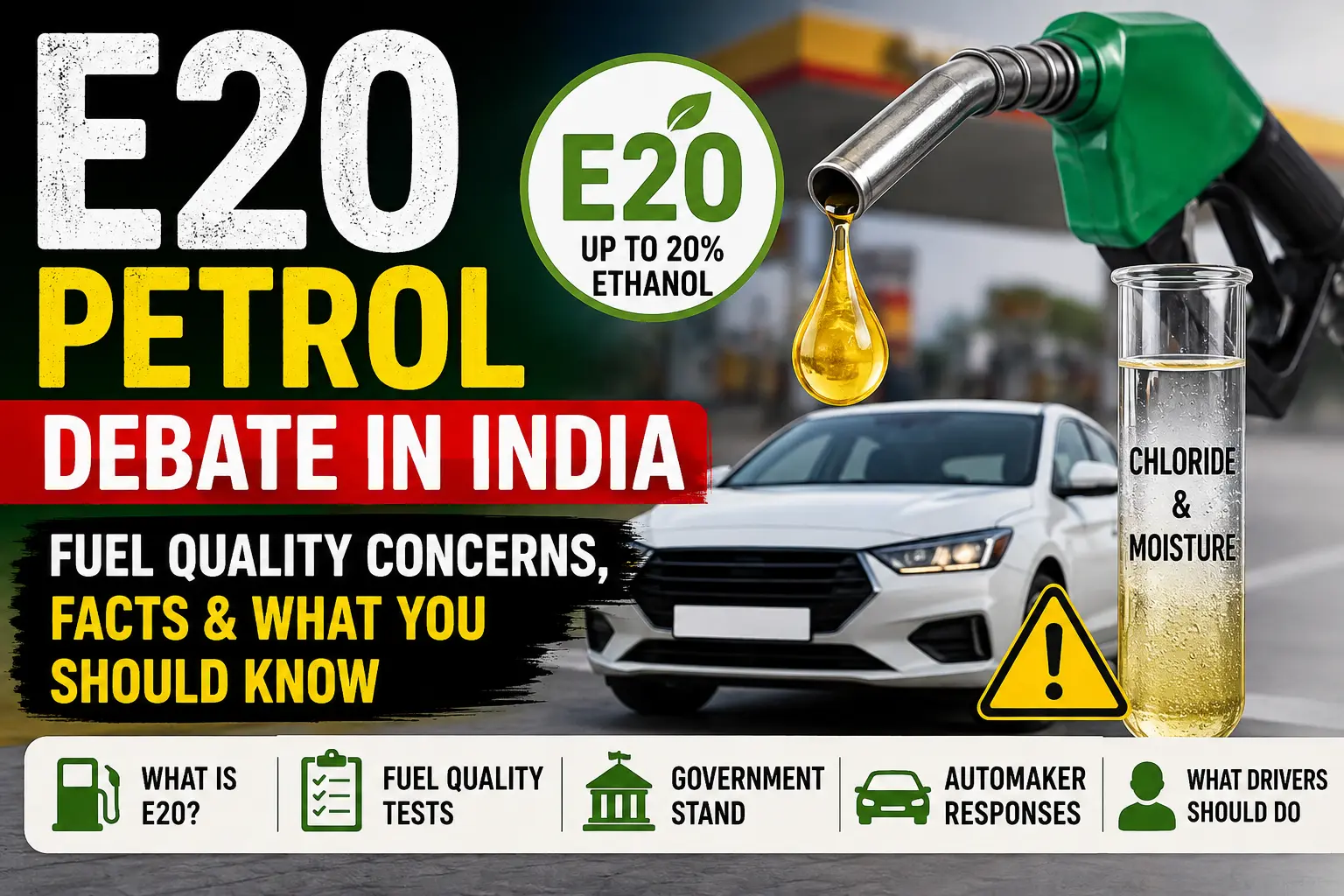
The debate over E20 petrol in India has entered a new phase, with fresh questions being raised about fuel quality. Ethanol-blended petrol has been at the centre of discussions involving vehicle manufacturers, oil companies, the government and consumers, and the latest developments have added a new dimension to the issue.
The current discussion is not only about the amount of ethanol mixed with petrol. Concerns over possible contamination in some fuel samples have also brought attention to storage, transportation and fuel-quality monitoring across the distribution network.
What is E20 petrol?
E20 is a petrol blend containing up to 20% ethanol. India has gradually increased the use of ethanol in petrol as part of its broader strategy to reduce dependence on crude oil imports and increase the use of domestically produced renewable fuel.
The move has been implemented in stages, with the country moving towards widespread availability of E20 petrol.
As E20 has become more common, questions about vehicle compatibility, fuel efficiency and long-term engine performance have also received greater attention.
What triggered the latest controversy?
The latest debate is centred on concerns over the quality of some fuel samples rather than the ethanol percentage alone.
Information that has emerged from the automotive industry points to concerns about substances such as chloride and moisture being found at elevated levels in certain samples.
If such contamination occurs, it could potentially contribute to corrosion or other problems in fuel-system components over time.
However, there is an important distinction to make.
Concerns involving particular fuel samples do not automatically mean that all E20 petrol sold across India is contaminated or below standard.
Current evidence does not indicate that this is a nationwide issue.
What do nationwide tests show?
Government-owned oil companies have carried out their own quality checks across different stages of the fuel supply chain.
Samples have been examined from refineries, ethanol production facilities, storage locations and distribution points.
According to the oil companies, their testing has not identified a widespread quality problem with E20 petrol.
They have also said that chloride levels in the tested samples remained within the prescribed limits.
Checks involving underground storage infrastructure at fuel stations have also been cited by the companies as part of their assessment of the issue.
This means that the available testing does not currently establish that the entire E20 distribution network is affected by a common contamination problem.
What is the government's position?
The central government has repeatedly defended the technical basis behind India's E20 programme.
According to the government's explanation, the transition to higher ethanol blending was not introduced without technical assessment.
Several organisations and stakeholders, including NITI Aayog, the Automotive Research Association of India, the Indian Institute of Petroleum, oil companies and automobile manufacturers, have been involved in consultations and testing related to ethanol blending.
The government has also pointed to testing of vehicles designed to operate with E20 fuel.
The Automotive Research Association of India has previously reported extensive validation work on E20-compatible vehicles, including long-distance testing.
The organisation has said that its testing did not indicate significant abnormal engine wear in vehicles designed for E20 use.
What about older petrol vehicles?
One of the most important parts of the E20 debate concerns vehicles that were already on Indian roads before the transition to higher ethanol blending.
Not every petrol vehicle was designed at the same time or with the same level of ethanol compatibility.
The suitability of E20 can therefore depend on the vehicle's manufacturing year, engine technology and the manufacturer's specifications.
Owners of older vehicles should check their vehicle handbook or the manufacturer's official recommendations instead of assuming that every petrol vehicle will respond to E20 in exactly the same way.
Why is moisture being discussed?
Ethanol has properties that make moisture management an important part of fuel storage and handling.
This means that the condition of storage tanks, transportation systems and fuel-station infrastructure can have a role in maintaining fuel quality.
If storage or handling systems are not properly maintained, external contamination can potentially affect fuel quality.
This is why the current debate needs to distinguish between the characteristics of E20 itself and possible contamination occurring somewhere during storage or distribution.
What happened with the industry association's complaint?
The Society of Indian Automobile Manufacturers has also been part of the wider discussion surrounding fuel quality.
Concerns about chloride and moisture levels in fuel were previously raised with the government, according to reports.
However, the communication was later withdrawn.
The industry association indicated that additional validation of the data was required and that further information needed to be collected.
The episode added another layer to the ongoing debate over E20 fuel quality.
What are automobile manufacturers saying?
Automobile manufacturers have taken different positions on various aspects of the E20 discussion.
Newer vehicles are increasingly being designed with higher ethanol blends in mind, while compatibility remains an important consideration for older vehicles.
The latest fuel-quality controversy should also be kept separate from the broader question of whether E20-compatible vehicles can operate normally on the fuel.
Mahindra has disputed some conclusions drawn from its internal communications, describing certain interpretations as incorrect and without basis.
This makes it important to distinguish between concerns raised during internal discussions and confirmed evidence of a nationwide vehicle or fuel-quality problem.
Does E20 reduce mileage?
Fuel efficiency is another major concern among vehicle owners.
Ethanol contains less energy per unit of volume than petrol, which can create differences in fuel consumption.
However, the actual change in mileage depends on several factors.
Engine design, driving conditions, traffic, tyre pressure, air-conditioning use and vehicle maintenance can all influence fuel efficiency.
Therefore, it would not be accurate to claim that every vehicle will experience the same reduction in mileage after switching to E20.
What should vehicle owners do?
The current information does not indicate that all vehicles using E20 will immediately develop engine problems.
The first step for owners should be to check the fuel recommendations provided by their vehicle manufacturer.
If a vehicle develops repeated starting problems, unusualenginebehaviour, reduced performance or other abnormal symptoms after refuelling, having it inspected by an authorised service centre would be a sensible step.
Owners who suspect a fuel-quality issue can also retain their fuel receipts and note the details of the fuel station, which may be useful if a formal complaint or technical investigation becomes necessary.
Why is E20 important for India?
The E20 programme is about more than changing the composition of petrol.
India is using ethanol blending as part of a broader effort to reduce crude oil import dependence, increase domestic ethanol production and expand the role of renewable fuel in the country's energy mix.
The programme also has links to the agricultural sector because a significant portion of India's ethanol production comes from agricultural feedstocks.
As a result, maintaining consistent fuel quality is important not only for vehicle owners but also for the wider fuel distribution system.
What needs to happen now?
The conflicting information surrounding fuel contamination makes further independent testing particularly important.
Quality checks need to cover the entire journey of fuel, from production and blending to storage, transportation and retail distribution.
If contamination is found in a particular location, investigators also need to establish where it entered the fuel supply chain.
Determining whether a problem originated during production, storage, transportation or at a specific fuel station would help separate isolated incidents from a wider systemic issue.
What can we conclude about E20 right now?
The available evidence does not justify describing all E20 petrol in India as unsafe or contaminated.
At the same time, concerns raised about specific fuel samples should not simply be dismissed.
The government and oil companies say their testing indicates that E20 meets the required quality standards.
Industry-related information, meanwhile, has raised questions about contamination in certain samples.
The most useful next step is therefore not to treat the issue as a simple argument over whether E20 is good or bad.
Instead, more transparent testing and detailed data are needed to determine the actual source, scale and impact of any contamination.
Conclusion
India's E20 petrol debate has entered a new stage as questions about fuel quality emerge alongside the existing discussions over ethanol blending.
Government agencies and technical bodies have maintained that vehicles designed for E20 have undergone extensive validation and that there is no established evidence of widespread abnormal engine wear.
At the same time, concerns involving chloride and moisture in certain fuel samples have highlighted the importance of stronger quality monitoring throughout the fuel supply chain.
The key question is therefore not simply whether E20 is safe or unsafe.
It is also about how the fuel is produced, stored, transported and tested before reaching consumers.
Further independent testing and transparent data will be important in determining whether the reported contamination concerns are isolated incidents or part of a broader fuel-quality issue.
Recommended Stories

Automobile
Mahindra BE 6 Sporteq Edition to Launch on August 15: What to Expect
Tamilxa News Desk•Aug 13, 2026