

India
Uttarakhand Tunnel Accident: Water and Debris Trap Workers
A sudden surge of water and debris entered an under-construction hydroelectric tunnel in Uttarakhand’s Chamoli district, killing workers and triggering a major rescue operation.
Language
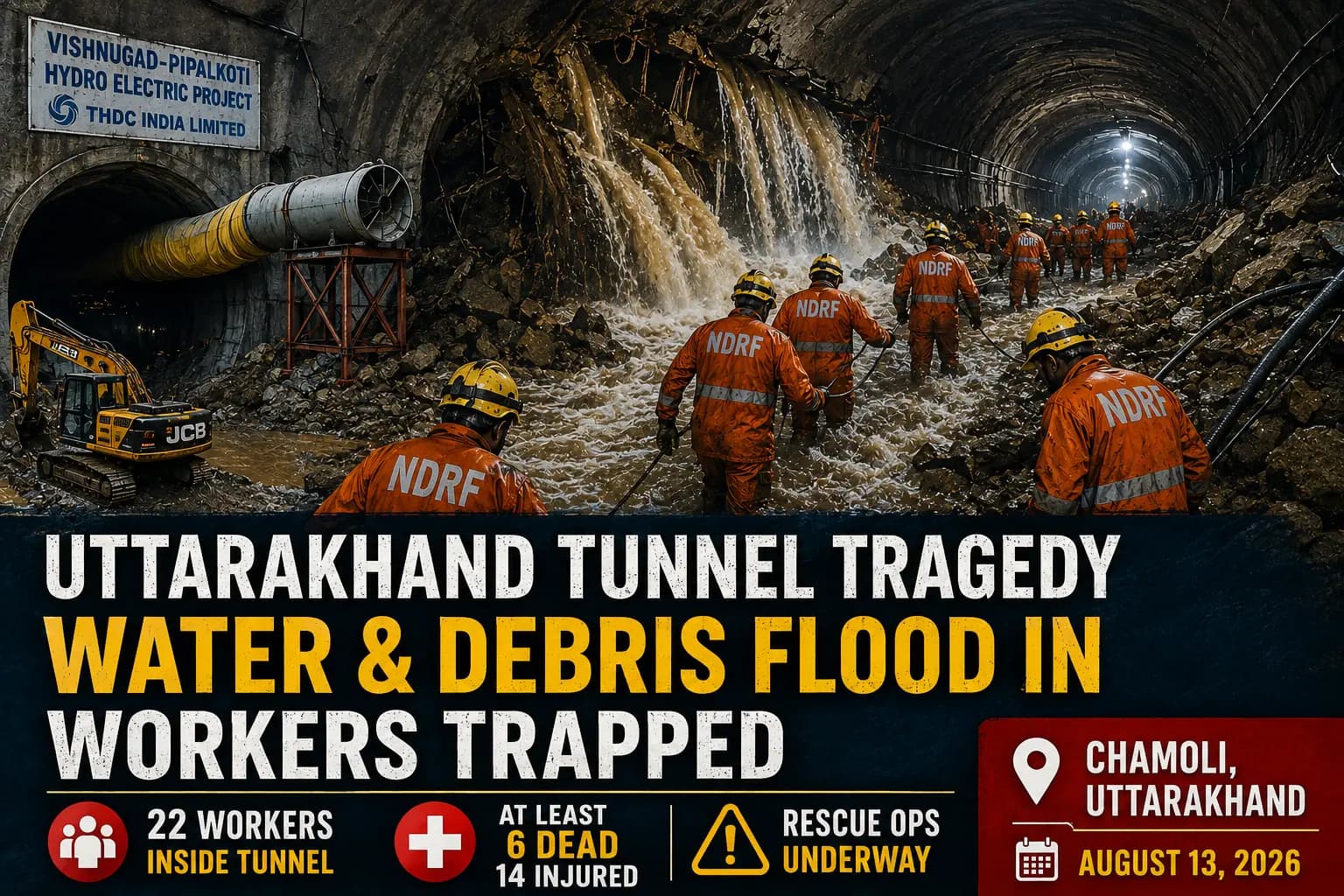
A major accident occurred at an under-construction hydropower tunnel in Uttarakhand’s Chamoli district on Thursday evening after a sudden surge of water and debris entered the tunnel, trapping workers inside.
The incident took place near Mayapur in the Pipalkoti area at the Vishnugad-Pipalkoti Hydroelectric Project, operated by THDC India Limited. The Vishnugad-Pipalkoti project is being developed by THDC India Limited, with Hindustan Construction Company involved in the project's civil and hydro-mechanical works.
According to the latest PTI-based information available in the early hours of August 14, 22 workers were inside the tunnel when the incident occurred. Twenty people were brought out, including 14 injured workers and six who were declared dead. Two others were still being searched for at that stage.
What happened inside the tunnel?
The incident was reported at around 6:30–7:00 pm on Thursday.
Officials said a large quantity of water and debris suddenly entered the under-construction tunnel while excavation work was underway. Workers reportedly heard a loud sound before the water and debris rushed into the tunnel.
Initial reports linked the incident to a landslide and the resulting inflow of water and debris. However, the exact technical cause of the accident has not yet been conclusively established.
The affected tunnel is part of the Vishnugad-Pipalkoti Hydroelectric Project in Chamoli, a mountainous region where construction work can be complicated by difficult terrain and changing water conditions.
Death toll and injuries
The casualty figures changed as rescue teams continued their operation.
PTI-based reports available around 1 am on August 14 said six workers had died and 14 others were injured. Twenty of the 22 workers initially reported inside the tunnel had been accounted for, leaving two people still to be located.
A later Hindustan Times update reported the death toll at seven, while also stating that 14 workers were injured. Because rescue operations and verification were still developing, the final official casualty figure may change.
For that reason, the confirmed minimum figure is more appropriate than presenting a single changing number as final.
Large rescue operation underway
Multiple agencies were deployed to the site after the accident.
Teams from the National Disaster Response Force (NDRF), State Disaster Response Force (SDRF), ITBP, CISF and the Army were involved in the rescue effort, along with local authorities and emergency personnel.
Rescuers had to work through water, loose debris and difficult tunnel conditions while trying to reach the remaining workers.
The Uttarakhand government said senior officials were monitoring the operation and that the priority was to safely evacuate everyone who remained trapped. Chief Minister Pushkar Singh Dhami also directed officials to ensure that all available resources were used for the rescue effort.
Which project is involved?
The accident occurred at the Vishnugad-Pipalkoti Hydroelectric Project, a 444 MW hydropower project in Chamoli district.
The project is being developed by THDC India Limited on the Alaknanda River. Official project documents identify it as a 444 MW project with four generating units of 111 MW each.
The project is still under construction, which means several tunnel sections and associated underground works remain part of the development process.
A project that has seen an earlier tunnel accident
The latest incident has also brought renewed attention to safety at the same hydropower project.
In December 2025, two internal locomotive trains collided inside a tunnel at the Vishnugad-Pipalkoti project, injuring dozens of workers. Reports at the time put the number of injured at around 60 or more, although different reports gave different figures.
However, there is currently no confirmed evidence that the earlier train collision was directly connected to Thursday’s water-and-debris incident.
The two events involved very different circumstances, and the latest accident will require a separate technical investigation.
What caused the accident?
The immediate trigger appears to have involved a sudden inflow of water and debris following a landslide or ground disturbance.
But it would be premature to declare a single cause before investigators examine the tunnel, surrounding geology, water movement and construction conditions.
Officials are expected to establish how the water entered the tunnel, why the debris reached the working area so quickly and whether any additional safety measures are required before construction resumes.
Why the rescue is difficult
Underground rescue operations become particularly challenging when water and loose material enter a tunnel suddenly.
Rescue teams have to remove debris while ensuring that the tunnel remains stable. At the same time, additional water inflow or movement of loose material can create new risks for rescuers.
This is why specialised teams and heavy equipment are being used rather than relying only on manual evacuation.
What happens next?
The immediate priority remains locating anyone still unaccounted for and providing medical treatment to the injured.
Once the rescue operation is completed, authorities will also need to determine the exact cause of the incident and examine whether changes are required in tunnel safety procedures.
The final death toll and the condition of the remaining workers are among the key developments to watch as the rescue operation continues.
For now, the confirmed picture is that a sudden inflow of water and debris struck an under-construction tunnel at the Vishnugad-Pipalkoti hydropower project in Chamoli, leaving workers dead and injured and prompting a large-scale multi-agency rescue operation.
Recommended Stories