
World
Major Oil Spill Reaches Oman Coast, Raising Environmental Concerns
Oil from the Caroline Bezengi tanker has reached Oman's mainland coast, raising concerns for marine life, fisheries and protected coastal areas.
Language
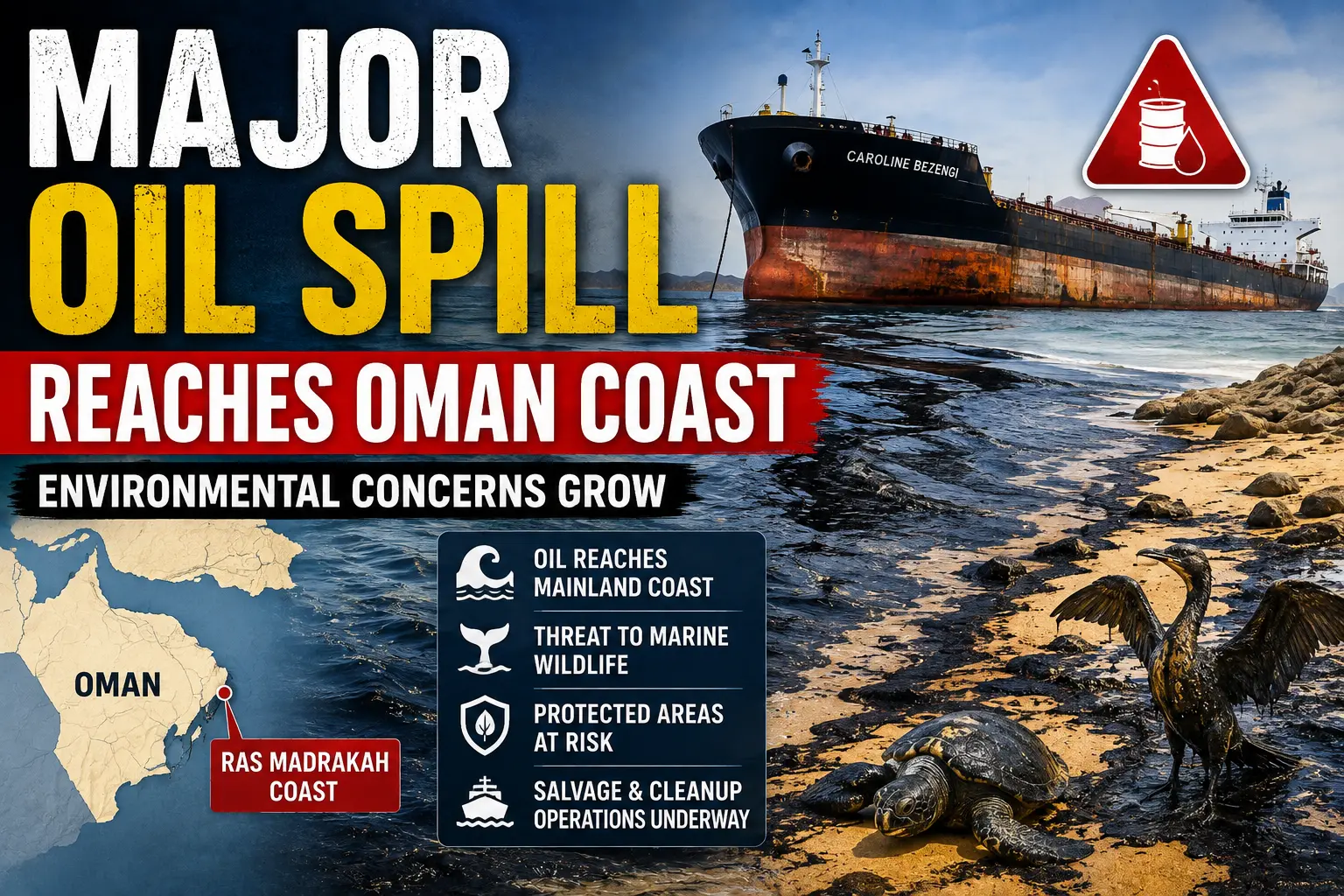
A major oil spill off the coast of Oman has developed into a growing environmental concern after crude oil from the tanker Caroline Bezengi reached parts of the country's mainland coastline.
The spill had been spreading through the sea for several weeks. With oil now reaching coastal areas, concerns have increased over its possible impact on marine ecosystems, fisheries and environmentally sensitive locations.
How did the oil spill happen?
The Caroline Bezengi was carrying crude oil after departing from Russia's Novorossiysk port.
The tanker encountered serious problems at sea in June and later became stranded in waters near Oman. Crude oil began leaking from the vessel and gradually spread across the surrounding waters.
The continuing leak has made efforts to stabilise the tanker and prevent further discharge particularly important.
Where has the oil reached?
The spill initially spread near the Hallaniyat Islands, an area known for its ecological importance.
Oil has now reached parts of Oman's mainland coastline, including the Ras Madrakah area.
There are also concerns that the slick could move towards other coastal locations, including areas around Masirah Island.
Satellite observations and environmental monitoring have indicated that the oil has spread across a significant area of the sea.
Why are marine animals at risk?
The affected waters are important habitats for several marine species.
The Hallaniyat Islands and surrounding waters support a variety of wildlife, including Arabian Sea humpback whales and Socotra cormorants.
Large oil spills can affect marine animals in several ways. Oil on the surface can contaminate birds and other animals, while polluted water can affect fish and other organisms living in the marine environment.
The longer oil remains in sensitive areas, the greater the possibility of long-term ecological consequences.
Protected areas are also a concern
The location of the spill has increased environmental concerns because of the proximity to areas with important conservation value.
The Hallaniyat Islands Nature Reserve supports a range of marine and coastal species.
If oil reaches sensitive habitats and remains there for an extended period, the effects could continue beyond the initial spill.
Impact on coastal areas
The situation is no longer limited to offshore waters because oil has reached the mainland coastline.
Oil can stick to beaches, rocks and coastal vegetation, making cleanup operations more complicated.
The condition of the shoreline will therefore need to be monitored closely as authorities continue their response.
Fisheries face uncertainty
Fishing is an important source of income for coastal communities in Oman.
If particular areas become contaminated, fishing activities could be restricted as a precaution.
Marine organisms exposed to oil may also be affected, creating concerns for fishermen whose livelihoods depend on healthy coastal waters.
Authorities step up the response
Omani authorities have been monitoring the movement of the oil and coordinating response operations.
Efforts are focused on limiting the spread of the spill and protecting vulnerable coastal areas.
Fishermen have also been advised to avoid affected areas while authorities assess the situation.
At the same time, salvage specialists are working to deal with the tanker and reduce the possibility of additional oil entering the sea.
Why is the salvage operation difficult?
Stabilising the Caroline Bezengi and removing the remaining crude oil are among the most important tasks.
However, weather and sea conditions can make salvage operations more difficult.
If the tanker suffers additional structural damage, more oil could potentially escape into the surrounding waters.
This makes the condition of the vessel an important factor in determining how the environmental situation develops.
How much oil was on the tanker?
Reports have given different estimates of the amount of crude oil carried by the vessel.
Some reports have put the figure at around 800,000 barrels, while other reports have described the cargo as approaching one million barrels.
Because the estimates vary, the final quantity should not be treated as confirmed until a definitive assessment is released.
The exact cause remains under investigation
The circumstances surrounding the tanker's damage have not been completely established.
Reports have raised questions about a possible explosion or attack, but the full circumstances remain unclear.
No definitive conclusion about responsibility should therefore be drawn until further investigation provides additional evidence.
Links to Russian oil shipments
The tanker was carrying crude oil from Russia when the incident occurred.
The vessel has also appeared in international sanctions-related records, adding another dimension to the incident beyond the environmental damage.
The case has raised questions surrounding the ownership, insurance and responsibility associated with the vessel, although several details remain subject to further clarification.
Why cleanup could become complicated
Large oil spills can require significant financial, technical and logistical resources to manage.
The condition of the tanker, the amount of oil remaining onboard, insurance arrangements and the legal circumstances surrounding the incident can all influence the response operation.
Weather and sea conditions can further complicate efforts to contain and remove the oil.
How large could the spill become?
It is still difficult to determine the final extent of the spill.
Ocean currents, wind direction, wave conditions and the condition of the tanker can all influence the movement of the oil slick.
If additional crude escapes from the damaged vessel, the affected area could expand further.
The coming days will therefore be important for determining whether the response operation can prevent the situation from becoming significantly worse.
International attention is also growing
The incident is attracting attention beyond Oman because the Arabian Sea is an important route for international shipping and energy transportation.
The region has also experienced maritime security incidents in recent months, making the safety of commercial vessels another issue surrounding the incident.
However, the environmental impact remains the immediate concern as authorities work to limit the spread of the oil.
What happens next?
The response operation currently has several priorities.
The first is to stabilise the Caroline Bezengi and prevent further damage to the vessel.
The second is to remove or contain the remaining crude oil onboard.
The third is to limit the spread of oil that has already entered the sea and protect vulnerable coastal and marine areas.
Omani authorities and specialist oil-spill response teams are continuing to work on these objectives.
Why the next few days matter
The ultimate environmental impact will depend on how quickly the remaining oil can be contained and how much of the existing slick reaches sensitive coastal habitats.
Monitoring will be particularly important around protected areas, fishing grounds and sections of coastline already affected by the spill.
The response will also determine whether the incident remains a serious but contained coastal pollution event or develops into a much larger environmental disaster.
Conclusion
The Caroline Bezengi oil spill has entered a more serious phase after crude oil reached Oman's mainland coastline.
The proximity of the spill to environmentally important areas around the Hallaniyat Islands has increased concerns over marine wildlife and coastal ecosystems.
The full scale of the environmental damage is not yet known, and estimates of the amount of oil involved have varied.
For now, the priority is to stabilise the tanker, prevent additional crude from entering the sea and contain the oil that has already spread.
The effectiveness of salvage and oil-spill response operations over the coming days will play a major role in determining the eventual environmental impact on Oman's coastline.
Recommended Stories