
World
UK Closes 13 More Asylum Hotels as 2026 Total Reaches 44
The UK has closed 13 more hotels used for asylum accommodation, taking the number of closures in 2026 to 44 as the government works to end hotel use.
Language
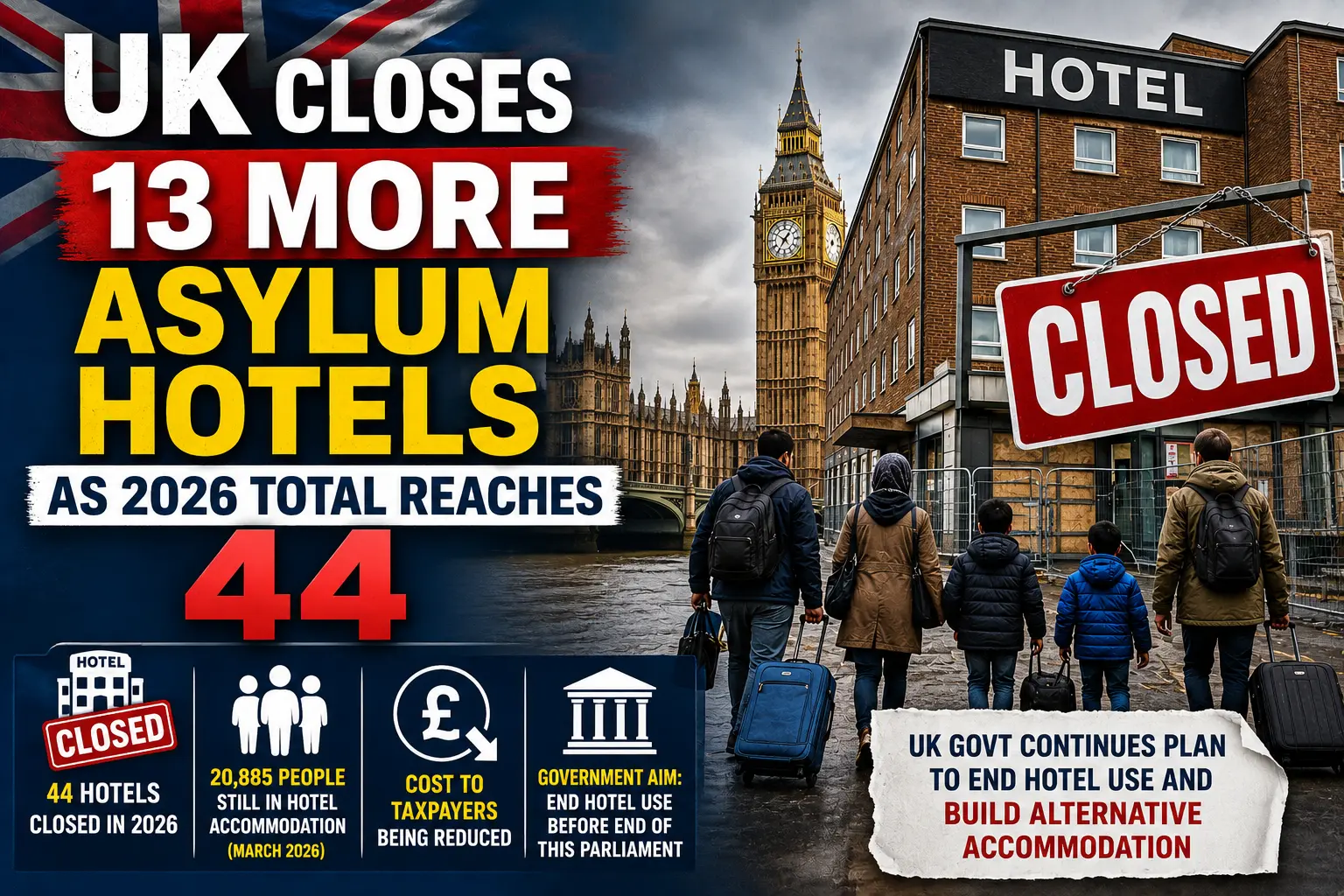
The UK has closed 13 more hotels that were being used to accommodate people seeking asylum. The latest closures bring the number of asylum hotels shut during 2026 to 44, as the government continues its plan to end the use of hotels for asylum accommodation.
13 more hotels closed
The UK government has been reducing its reliance on hotels to accommodate asylum seekers. The latest round of closures means that 44 hotels have now been closed during 2026.
The government has said it wants to close all asylum hotels as part of a wider plan to reduce costs, increase the use of alternative accommodation and speed up decisions on asylum claims.
Why is the UK closing asylum hotels?
The government has argued that using hotels for asylum accommodation is expensive and should not be a long-term solution.
Hotel use reached its highest level in 2023, when more than 400 hotels were being used across the UK. The government previously said the cost of hotel accommodation had reached almost £9 million a day at that peak.
Since then, the number of hotels and the number of asylum seekers staying in them have fallen significantly.
How many asylum seekers are still staying in hotels?
Official UK government figures show that 20,885 people were staying in hotel accommodation at the end of March 2026.
That figure was 35% lower than at the end of March 2025. It was also 63% lower than the peak of 56,018 people recorded in September 2023.
The figures show a substantial reduction in the use of hotels, although they remain part of the country's asylum accommodation system.
What will replace the hotels?
The government is increasing the use of other forms of accommodation as hotels are closed.
These include larger sites and former military facilities that can accommodate significant numbers of people. The aim is to reduce the cost of accommodation while creating a system that the government says can be managed more efficiently.
The move to alternative accommodation is also intended to reduce the UK's dependence on commercial hotels.
Government aims to end hotel use
Ending the use of asylum hotels is one of the UK government's stated priorities.
The government has said that it wants to close every asylum hotel before the end of the current Parliament.
To achieve that goal, it is pursuing several measures, including speeding up asylum decisions, increasing the use of alternative accommodation and increasing returns of people who do not have a legal basis to remain in the UK.
The government has also been working to make greater use of existing accommodation capacity.
The debate over alternative accommodation
Although the closure of hotels has been welcomed by the government as a way to reduce costs, alternative accommodation has also created controversy in some communities.
Plans to accommodate asylum seekers at former military sites and other large facilities have faced opposition from some local residents and politicians.
In some locations, residents have raised concerns about pressure on local services, infrastructure and the lack of consultation.
The government, however, argues that asylum accommodation should be distributed more fairly across the country instead of being concentrated in particular areas.
Calls for a fairer distribution
The question of where asylum seekers should be accommodated has become an increasingly important part of the political debate.
Government representatives have argued that wealthier and middle-class areas should also share responsibility for accommodating asylum seekers.
The government says a more balanced distribution would prevent a small number of communities from carrying a disproportionate share of the responsibility.
Local tensions continue
The debate has also led to protests in some parts of the country.
Thetford in Norfolk has recently experienced unrest linked to opposition to asylum accommodation plans. Reports have described property damage, clashes with police and concerns about misinformation surrounding asylum housing.
However, reactions have varied from one community to another. Some areas have experienced opposition, while others have accommodated asylum seekers without major disruption.
Why does the issue matter?
The closure of asylum hotels is not simply a question of reducing the number of buildings being used.
It also raises questions about where asylum seekers will live after hotels close, whether alternative accommodation is suitable and how local communities will be affected.
The government says moving away from hotels will save money and create a more sustainable accommodation system.
Critics, meanwhile, argue that closing hotels without adequate planning for replacement accommodation could simply move the problem from one location to another.
The wider asylum system
The hotel debate is part of a much larger discussion about the UK's asylum system.
Official figures show that 94,000 people claimed asylum in the UK in the year ending March 2026. At the end of March 2026, 97,519 people were receiving asylum support.
The number of people in hotel accommodation has fallen considerably, while more people are being accommodated through other forms of housing.
This shift is central to the government's strategy to reduce its reliance on hotels.
What happens next?
The UK government is expected to continue closing asylum hotels while expanding alternative accommodation.
The number of hotels in use is likely to fall further as the government works towards its target of ending hotel accommodation during the current Parliament.
At the same time, decisions over where alternative accommodation should be located and how local communities should be consulted are likely to remain major political issues.
Conclusion
The UK has closed 13 more hotels used to accommodate people seeking asylum, bringing the number of asylum hotels closed during 2026 to 44.
Official figures also show that 20,885 people were still staying in hotel accommodation at the end of March 2026, although that was 35% lower than a year earlier.
The government wants to end the use of hotels and replace them with other forms of accommodation.
The next stage will therefore focus not only on closing more hotels, but also on whether the alternative accommodation system can meet the needs of asylum seekers while addressing concerns raised by local communities.
Recommended Stories
World
Major Oil Spill Reaches Oman Coast, Raising Environmental Concerns
Tamilxa News Desk•Aug 13, 2026